What if the reason your best employees are quietly quitting has nothing to do with salary, culture, or their manager? What if everything had to do with the fact that nobody ever told them if they were doing a good job?
It sounds simple. But a lack of structured, consistent performance feedback is one of the most underestimated drivers of employee disengagement, and most organizations don’t catch it until the resignation letter lands.
The right employee performance management software doesn’t just run review cycles. It closes that gap before it becomes a vacancy.
Gallup’s State of the Global Workplace 2026 report found that only 20% of employees worldwide were engaged at work in 2025, the lowest level since 2020, costing the global economy roughly $10 trillion a year in lost productivity. The sharper warning sits one layer up: manager engagement fell from 31% in 2022 to 22% in 2025. When managers disengage, review cycles turn into paperwork and performance conversations stop happening at all.
Having spent nearly a decade in talent acquisition, I’ve watched companies transform team performance by choosing the right software like PeopleGoal, and seen others waste months on tools that looked great in a demo and failed at rollout.
PeopleGoal is a fully customizable performance management platform for performance reviews, OKRs, and employee development, built to scale from mid-market teams to enterprise organizations running thousands of employees across multiple review cycles. It’s the tool I keep returning to for companies that need the process to fit how they actually work. Paid plans start at $4/user/month with a 14-day free trial, no credit card required.
So to save you that pain, here are the best options I’d actually recommend, and what makes each one worth your time.
Let’s start with the basics:
What Is Employee Performance Management Software?
Employee performance management software is a digital platform that lets organizations set goals, collect continuous feedback, run structured performance reviews, and track individual and team progress in one place. Unlike traditional annual appraisals, modern performance management tools support real-time coaching, OKR tracking, 360-degree feedback, and development planning on a continuous cycle. PeopleGoal, Lattice, and 15Five are among the most widely used platforms in this category.
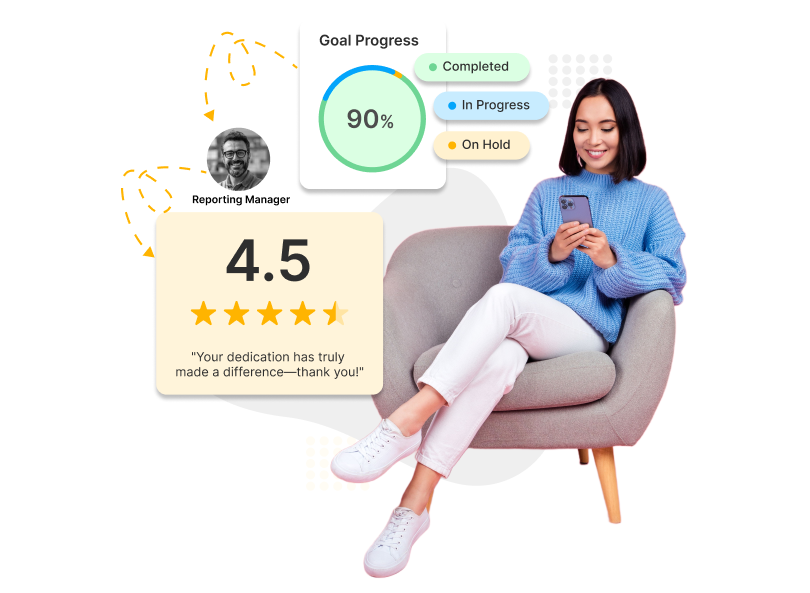
The key functions of employee performance management software include:
- Goal setting: OKRs, SMART goals, and KPIs, with cascading alignment from company to individual
- Continuous feedback: check-ins, one-to-ones, real-time praise, and performance journals
- Review workflows: self, manager, peer, multi-manager, and 360-degree review cycles
- Calibration: normalizing ratings across managers so compensation decisions hold up
- Analytics dashboards for managers and HR, covering completion rates, goal progress, and engagement trends
- Engagement: employee engagement surveys, pulse checks, and recognition programs
- Integrations with HRIS, payroll, Slack, Microsoft Teams, and SSO
According to Gartner, HR leaders say that leader and manager development is their top priority, and performance management software is a primary vehicle for improving it.
Performance Management Software vs HRIS vs Performance Review Software
These three terms get used interchangeably, and they are not the same thing. Getting the distinction right saves you from buying the wrong category.
- An HRIS is your system of record: payroll, employee data, time off, and compliance. BambooHR and Workday sit here.
- Performance management software is your system of work for goals, feedback, reviews, and development. PeopleGoal, Lattice, and 15Five sit here.
- Performance review software is a narrower slice, focused only on running the appraisal cycle itself.
Most HRIS platforms bundle a performance module, but it’s usually rigid: fixed rating scales, one review template, limited 360 logic. That rigidity is the single most common reason teams buy a dedicated tool after outgrowing their HRIS. PeopleGoal exists specifically for that moment, because its review workflows, rating scales, and cadences are all configurable without developer support.
Top 10 Employee Performance Management Software
The best employee performance management software in 2026 is PeopleGoal for fully customizable reviews and OKRs, Lattice for enterprise scale, 15Five for manager coaching, Leapsome for learning-linked development, and BambooHR for small HR teams. Here’s how they compare on use case, cost, and rating.
Want to see how some of these top performance management tools compare in action? This quick video breaks down their strengths, use cases, and the teams they’re best suited for.
| Tool | Best Use Case | Starting Cost | G2 Rating |
| PeopleGoal | Fully Customizable Performance Reviews, OKRs & Employee Development at Mid-Market and Enterprise Scale | FREE 14-day trial, no card. Paid starts at $4/user/month. | 4.5/5 |
| Lattice | Enterprise Scale & HRIS-Connected Analytics | Starts at $11/user/month. | 4.7/5 |
| 15Five | Manager Coaching & Weekly Check-Ins | Starts at $11/user/month. | 4.6/5 |
| Leapsome | Personalized Learning Paths | Custom pricing. 14-day free trial. | 4.8/5 |
| BambooHR | Small HR Teams Wanting HRIS Plus Reviews | Custom pricing. 7-day free trial. | 4.5/5 |
| PerformYard | Flexible Review Cycles | Starts at $5 to $10/user/month. | 4.7/5 |
| Culture Amp | Engagement Analytics & Benchmarking | Custom pricing. | 4.5/5 |
| Betterworks | Enterprise Goal Management & Calibration | Custom pricing. | 4.2/5 |
| Teamflect | Microsoft 365 & Teams-Native Performance | Free plan available. Paid from $7/user/month. | 4.7/5 |
| PeopleBox | Configurable OKRs for Mid-Market Teams | Starts at $8/employee/month. | 4.3/5 |
Ratings sourced from G2 and Capterra, verified September 2026. Pricing is list pricing and changes, so confirm with each vendor.
Now, here’s a detailed review of the top performance management software in the market, along with their best features, pros, cons, and pricing, to help you better understand them.
1. PeopleGoal
Best for Fully Customizable Performance Reviews, OKRs & Employee Development
If I had to pick one platform that genuinely bridges the gap between employee performance tracking and employee engagement, it’s PeopleGoal. Most tools treat these as separate modules that talk to each other badly.
PeopleGoal builds engagement signals, pulse surveys, recognition, one-to-ones, directly into the same workspace where goals and reviews live. For HR teams managing anything from a few hundred people to enterprise organizations with thousands of employees across multiple departments and overlapping review cycles, that unified context makes performance conversations significantly more productive. Role-based permissions, SSO, and cascading goal structures mean it holds up at scale rather than buckling once headcount grows.
The differentiator worth naming is how far the customization goes. Instead of picking from a fixed menu of review templates, HR teams build their own workflows, from OKR cycles to onboarding journeys to 360 forms with weighted rater groups, without filing a ticket with engineering. That matters more than it sounds. The most common reason a rollout fails is that the software forces a process the company does not actually run.
It has customizable workflows and templates that make it easy to track performance metrics without overcomplicating things. Its AI-powered performance management capabilities help managers summarize feedback, identify trends, and reduce the manual effort involved in performance reviews. Plus, the feedback system fosters continuous improvement, creating a culture where employees actually want to grow.
Built-in calibration is the other feature I’d flag, and almost nobody talks about it. When two managers rate identical performance differently, your compensation decisions stop being defensible. PeopleGoal lets HR normalize ratings across managers before anything is finalized, which is what turns a review cycle into a fair one.
The engagement features are a cherry on top. You can set up recognition programs or pulse surveys to gauge team morale. Honestly, it’s one of those tools that doesn’t just measure performance but actively enhances it.
Pros:
- The platform offers a wide range of templates for goal setting and 360-degree feedback processes, with configurable anonymity and weighted rater groups.
- You can use OKRs, SMART goals & weekly tasks to ensure the team moves together in the same direction, with cascading alignment from company level down to individuals.
- It enables you to use check-ins, one-to-ones, and continuous feedback to assess and improve performance across the year, not just at review time.
- You can leverage peer reviews and multiple-manager reviews to offer a well-rounded assessment of employee performance.
- Calibration tools reduce rating bias across managers before compensation decisions are locked in.
- Career paths, succession planning, and development plans are built in rather than sold as add-ons.
- The platform features a mobile-friendly interface and allows seamless integration with other HRIS tools, plus Slack and Microsoft Teams for in-the-flow feedback.
Cons:
- No downloadable or on-premise version.
- The dark user interface option is not available.
Pricing: FREE 14-day trial with full product access and no credit card required. Paid starts at $4/user/month.
Case Study:
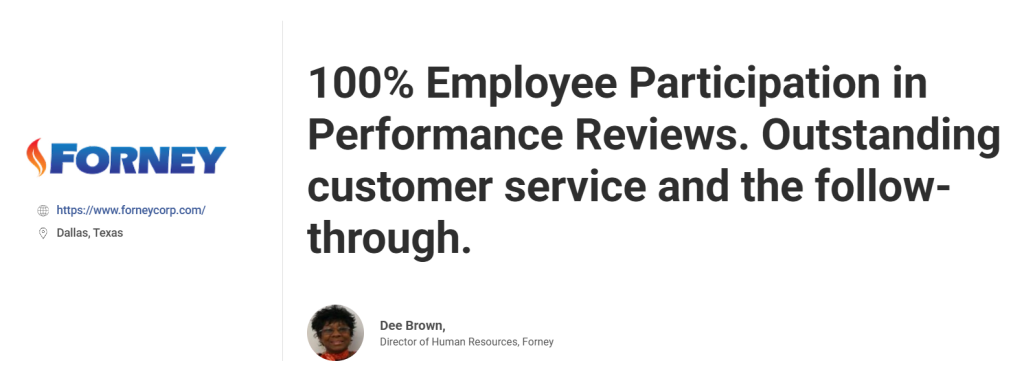
Check how Forney Corporation achieved 100% employee participation in performance reviews using PeopleGoal
2. Lattice
Best for Enterprise Scale and HRIS-Connected Analytics
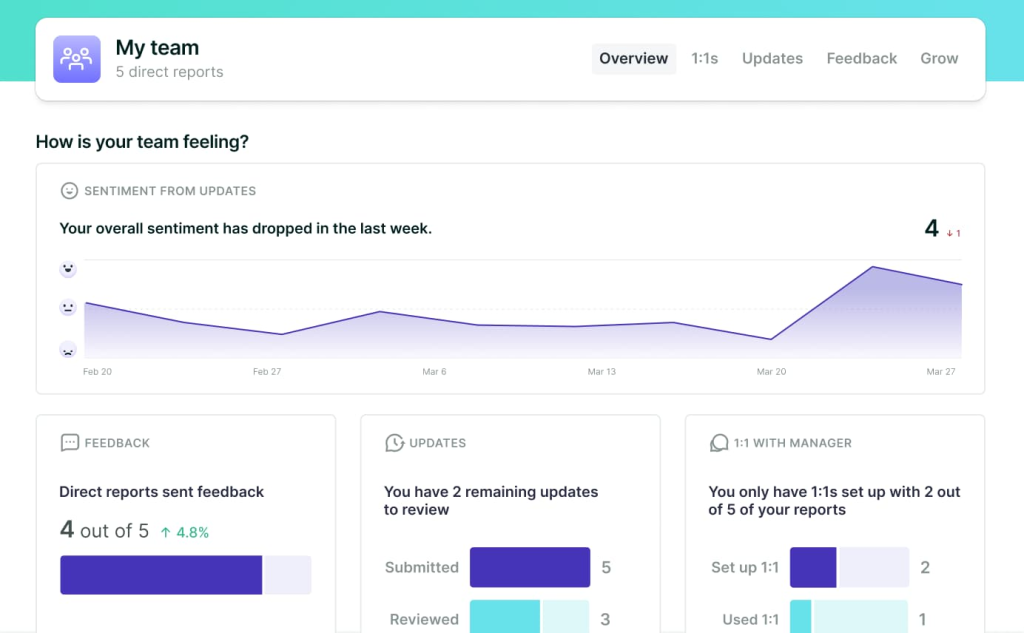
Lattice is a familiar name among enterprise HR teams, and its value sits in the reporting layer. Rather than keeping separate systems for reviews, goal-tracking, and engagement, Lattice pulls all three into a single analytics view.
For large organizations managing multiple departments and review cycles simultaneously, that visibility is hard to replicate in fragmented tools.
What stands out to me is how well it caters to the specific needs of large enterprises, whether it’s automating workflows or centralizing reviews for a giant workforce. The career-track templates are the real differentiator, giving employees a visible progression framework instead of a vague promise that growth will be discussed at some point. And the OKR tracking? Absolutely clutch when you’re managing multiple departments.
Pros:
- Lattice combines performance reviews, feedback, and employee engagement surveys into one comprehensive platform.
- Managers can easily schedule one-on-one meetings directly within the tool.
- A comprehensive analytics dashboard is provided for gaining real-time insights.
- Customizable career progression tracks help employees see the path to the next level.
- Lattice integrates seamlessly with popular collaboration tools such as Slack, Google Workspace, and Microsoft Teams.
Cons:
- Notifications can become overwhelming, especially for larger teams.
- Multiple reviewers report a steep learning curve during setup.
- Engagement, growth, and compensation are priced as add-ons on top of the base plan.
Pricing: Starts at $11/user/month billed annually. Add-ons run roughly $4 to $6/user/month.
3. 15Five
Best for Manager Coaching and Weekly Check-Ins
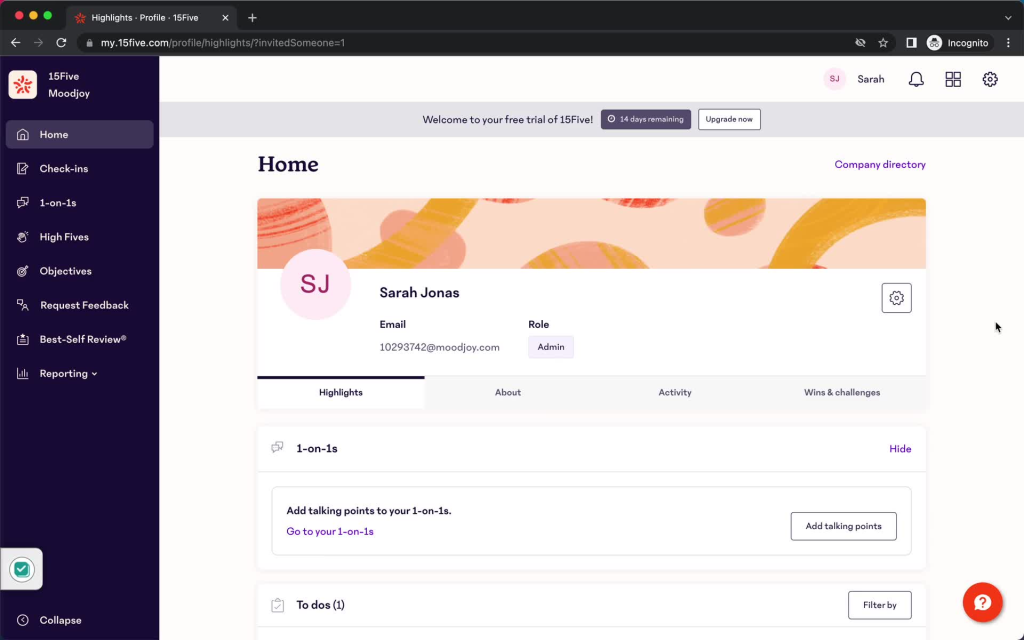
15Five is one of those tools that makes performance reviews actually feel meaningful. I’ve personally used it in one of my earlier organizations, and it stood out for how well it scales.
The continuous feedback model keeps conversations going throughout the year instead of just once or twice. Its weekly check-in rhythm surfaces problems while they’re still fixable, and the built-in manager coaching content is a genuine differentiator for companies investing in leadership development. Given the manager engagement collapse in Gallup’s 2026 data, that’s where most of the leverage sits right now.
The best part is that managers get a clear roadmap for one-on-ones, making discussions more productive and less awkward. Its AI layer surfaces sentiment and drafts review content, while the meeting assistant generates agendas, notes, and action items so managers spend the hour talking instead of typing.
Pros:
- Weekly check-ins are available to track employee sentiment and resolve issues promptly.
- The platform includes tools for managing OKRs and tracking goals effectively.
- Coaching tools are provided to help managers support and develop their teams.
- Analytics tools offer insights into engagement trends and areas for improvement.
- Integration with collaboration tools like Slack enhances usability and accessibility.
Cons:
- Entry-level plans are too limited for most teams, and the pricing structure may not suit smaller organizations.
- Heavy notification volume can distract employees.
- The mobile app offers limited functionality for conducting performance reviews.
Pricing: Starts at $11/user/month. Billed annually. 14-day free trial.
4. Leapsome
Best for Personalized Learning Paths
(Image Source: Software Advice)
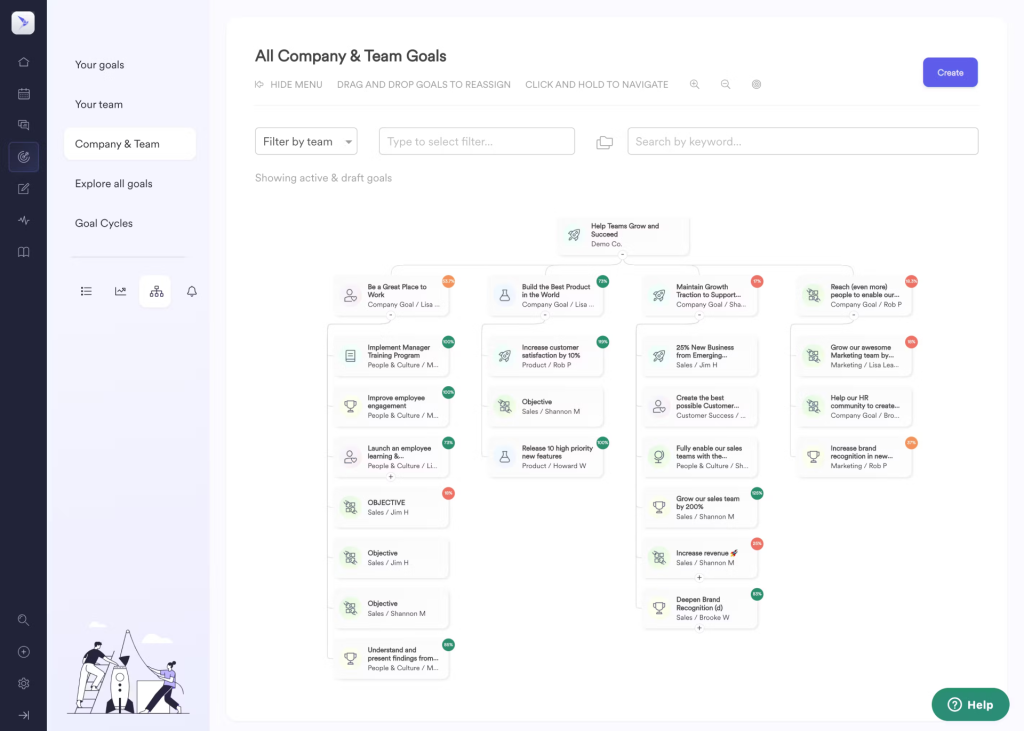
Leapsome is a strong option for performance management if you’re looking to combine performance management with employee development.
Leapsome sits at the intersection of performance management and learning, making it a strong fit for organizations that treat employee development as a strategic priority rather than an HR formality.
Its standout capability is connecting performance review outcomes directly to personalized learning paths, so development plans are driven by real performance data rather than generic role-based training.
It’s like having a custom-built career roadmap for every team member. The automated workflows are the other reason teams pick it: review cycles run on customizable rules, and the AI assistant turns notes into actionable tasks and recommends growth options.
Pros:
- It combines performance reviews, engagement surveys, OKRs, and learning into one platform.
- Tools for continuous feedback and coaching are included to encourage ongoing development.
- Strong automation for review cycles with rule-based triggers.
- 360-degree feedback capabilities offer a holistic view of employee performance.
- The software integrates with popular HR tools, enhancing overall usability.
Cons:
- Pricing is not published and quotes can be slow to obtain.
- Customization options may require technical expertise for effective implementation.
- Users report occasional technical issues and an initial learning curve.
Pricing: Custom pricing. 14-day free trial.
5. BambooHR
Best for Small HR Teams That Want HRIS Plus Reviews
(Image Source: People Managing People)
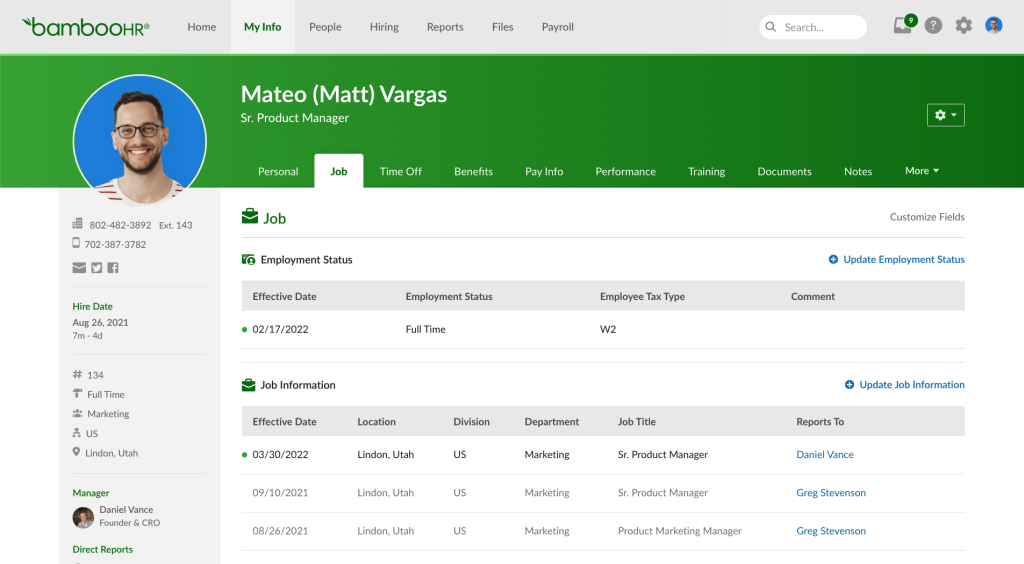
BambooHR is one of the best HR performance management software platforms I have worked with. It is efficient, organized, and always on top of things. I used it during a project that required streamlining HR processes, and it handled everything from hiring to payroll without breaking a sweat.
It’s the pick when you want core HR and performance in one place and your HR team is small enough that adding a second system is a real cost. It integrates HRIS functionality with payroll management, so you’re not juggling two systems. It’s user-friendly but still packed with features, like detailed employee records, time-off tracking, and onboarding checklists.
The mobile apps are the strongest in this list. Managers can create, track, and share goals, get notified on goal progress and completion, and see team status from a single screen. The payroll automation is also quite good: accurate, timely, and stress-free.
Pros:
- The software provides tools for tracking goals and generating detailed performance reports.
- Employee self-assessment features encourage active participation in the review process.
- Strong data security measures are in place to protect sensitive employee information.
- Integrated workflows make onboarding and performance management more streamlined.
- Genuinely full-featured mobile apps for iOS and Android.
Cons:
- Performance management features are only accessible in higher-tier plans, limiting availability for some users.
- Less customization than dedicated performance platforms.
- Costs add up quickly for smaller businesses.
Pricing: Custom pricing, typically from around $17/employee/month depending on plan. 7-day free trial.
6. PerformYard
Best for Flexible Review Cycles
(Image Source: TechCrunch)
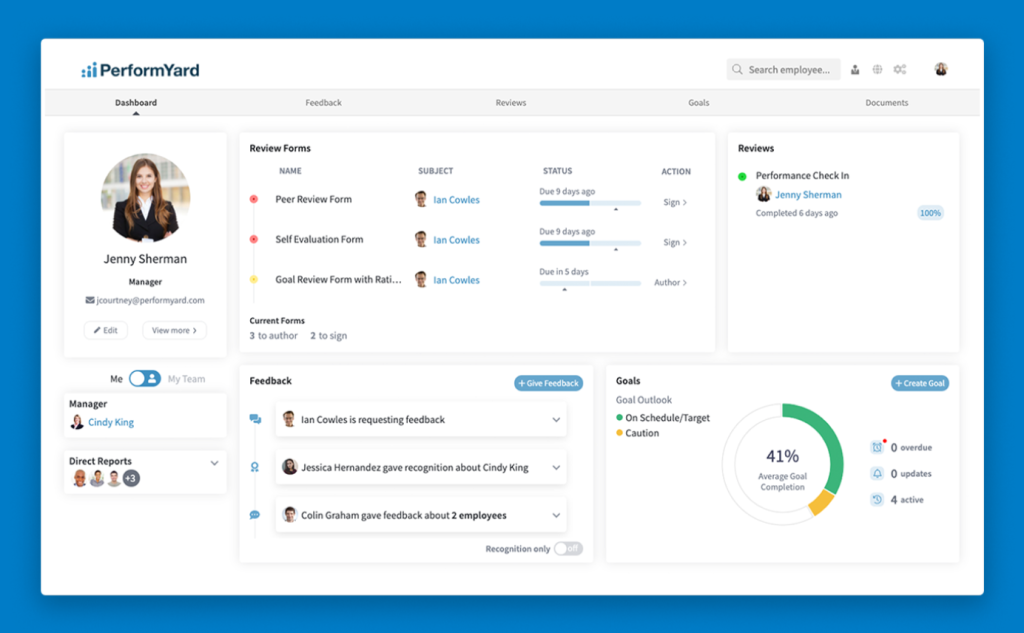
PerformYard is the go-to tool when your team’s review cycles don’t fit the cookie-cutter annual model. I’ve worked with teams that needed quarterly, project-based, or even ad-hoc reviews, and this tool handled it like a pro.
Its flexibility lets you create review schedules that match how your team actually works, not how someone else thinks they should. What I appreciate most is how it combines structured feedback with goal alignment.
Managers can focus on coaching while employees get clarity on their growth trajectory. It’s performance reviews without the usual drama or dread.
Pros:
- The software provides a centralized hub where all performance management activities can be managed efficiently.
- It includes tools for setting custom goals and tracking progress effectively.
- The platform enables 360-degree feedback to gather insights from multiple sources.
- AI-assisted drafting surfaces performance insights and recommended actions.
- Automated reminders and notifications simplify the review process for managers and employees.
Cons:
- Reporting capabilities may not meet the needs of organizations seeking advanced analytics.
- Roughly 15 integrations, fewer than most competitors.
- Annual billing only, with no monthly payment option.
Pricing: Starts at $5 to $10/user/month. Billed annually.
7. Culture Amp
Best for Engagement Analytics and Benchmarking

Culture Amp came at performance management from the engagement side, and it still shows in the best possible way. Its benchmarking data is the differentiator: you’re not just seeing your own engagement score, you’re seeing it against comparable companies by size, industry, and stage.
For HR leaders who need to justify a performance program to a skeptical exec team, that external comparison does more work than any internal dashboard. I’ve seen a single benchmark slide unlock budget that six months of internal reporting couldn’t.
The performance module has matured, covering reviews, goals, and development, but the analytics remain the reason to buy it.
Pros:
- Deep engagement benchmarking against external datasets from comparable companies.
- Strong survey design backed by science-based question banks.
- Reviews, goals, and development plans sit in the same platform as engagement data.
- Well-regarded people analytics and reporting for HR leadership.
Cons:
- Performance features are less configurable than dedicated performance platforms.
- Priced for mid-market and enterprise budgets.
- Pricing is not published.
Pricing: Custom pricing.
8. Betterworks
Best for Enterprise Goal Management and Calibration

Betterworks is built for large organizations where the hard problem isn’t running reviews but making ratings defensible. Its calibration workflows let HR run structured sessions where managers compare ratings across teams before anything is finalized.
That’s what keeps compensation decisions from turning into a fairness complaint. If your organization is big enough that two managers rating identical performance differently creates a real legal and retention risk, this is the category Betterworks owns.
Worth noting that PeopleGoal offers the same enterprise calibration capability with a far shorter implementation, so you get defensible ratings across a large workforce without a multi-month rollout.
Pros:
- Strong calibration and rating normalization tools across managers and departments.
- Enterprise-grade goal management with deep cascading across org levels.
- Reviews connect directly to compensation and succession planning.
- Built to handle complex, multi-level organizational structures.
Cons:
- Overbuilt for small and mid-sized teams.
- Implementation takes noticeably longer than lighter tools.
- The interface feels more enterprise than modern.
Pricing: Custom pricing.
9. Teamflect
Best for Microsoft 365 and Teams-Native Performance
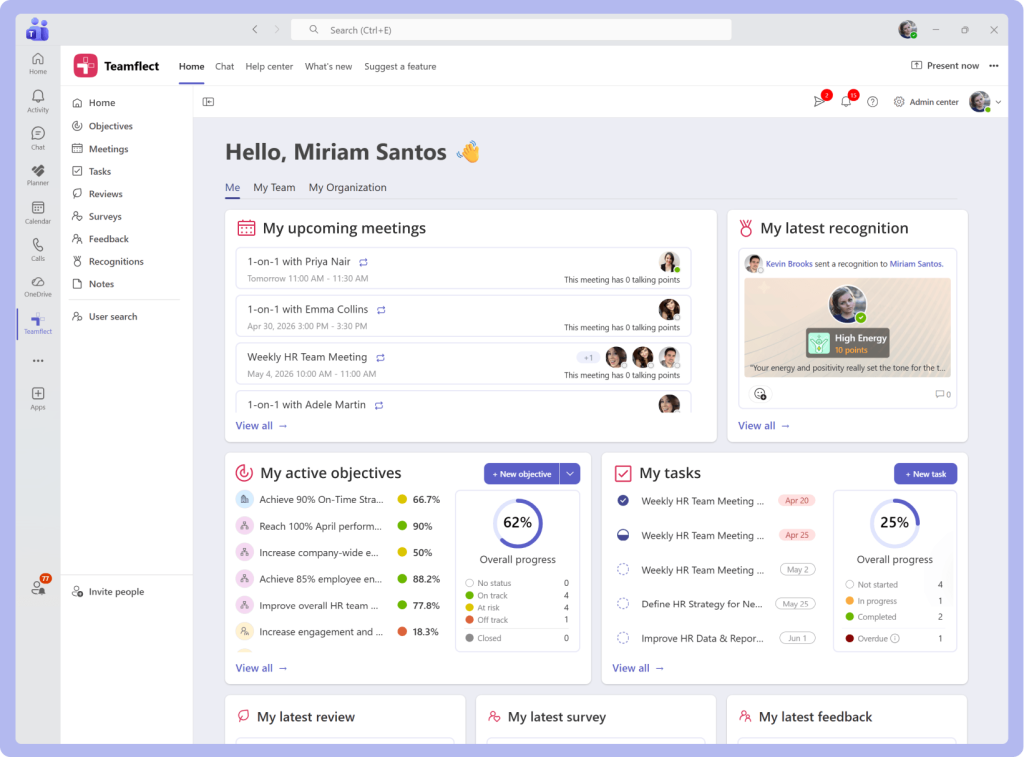
Teamflect solves one problem completely. If your company lives inside Microsoft Teams and Outlook, getting people to log into a separate HR tool is a losing battle. Teamflect runs reviews, OKRs, one-on-ones, and recognition inside Teams itself, so managers give feedback in the app they already have open.
Adoption is the metric that decides whether a performance program works at all, and this is the cleanest adoption story in the list for Microsoft-first organizations. If your stack is Slack and Google Workspace instead, PeopleGoal’s native Slack integration gives you the same in-the-flow feedback without the Microsoft dependency.
Pros:
- Fully native to Microsoft Teams and Outlook with no separate login to manage.
- Reviews, goals, one-on-ones, and recognition all run without app switching.
- A free plan is available for small teams.
- Fast setup, with most teams live in days rather than weeks.
Cons:
- Only makes sense for Microsoft 365 organizations.
- Analytics are lighter than standalone performance platforms.
- Limited value if your team runs on Slack and Google Workspace.
Pricing: Free plan available. Paid plans from around $7/user/month.
10. PeopleBox
Best for Configurable OKRs and Performance Management
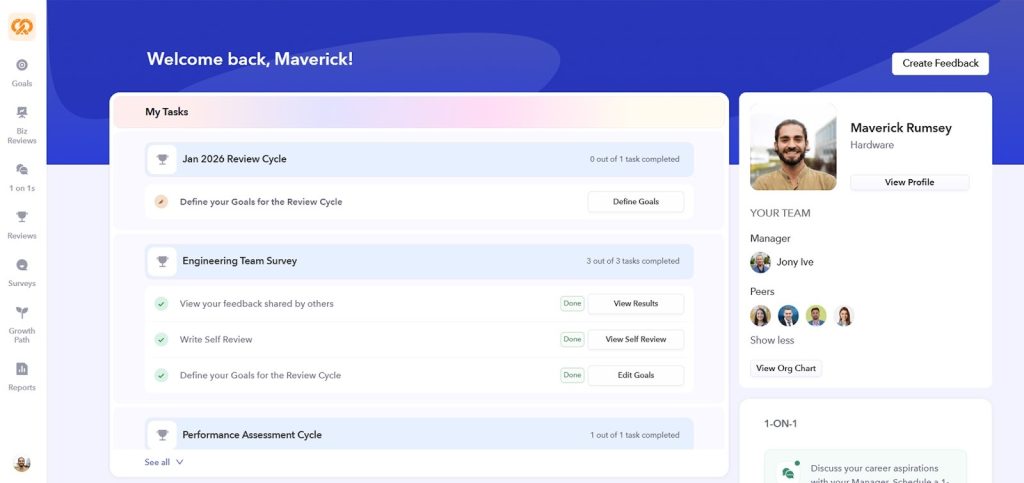
Peoplebox is an all-in-one talent management platform designed for mid-market companies that have outgrown the rigid performance modules of their HRIS. It combines OKRs, performance reviews, 360-degree feedback, 1:1s, engagement surveys, compensation planning, and individual development plans into a single, deeply configurable system, giving HR teams the flexibility to run performance management their way.
This staff performance management software is particularly effective for organizations that are serious about OKR adoption but struggling to create the vertical alignment between individual, team, and company objectives.
What sets it apart from generic goal-tracking tools is the coaching layer; managers get concrete visibility into how their team’s OKRs are progressing before the quarter ends, not after.
Pros:
- Deeply configurable review workflows, rating scales, and cadences let HR teams run performance management exactly the way they want, not the way their HRIS forces them to.
- Native Slack and Microsoft Teams integration means employees never have to log into a separate tool, driving high adoption rates.
- Cascaded OKRs connect company priorities down to every individual, keeping teams aligned as they scale.
- AI-powered goal creation and 360-degree feedback reports surface insights faster, reducing manual HR work.
- Most teams go live within a week, with 35+ integrations covering all major HRIS, ATS, and project management tools.
Cons:
- The platform is meant for mid-market companies, so very small teams or large enterprises may find it either too heavy or not enterprise-grade enough.
- Advanced modules like compensation planning, 360-degree feedback, and engagement surveys are available as add-ons, which add to the base cost.
Pricing: Starts at $8/employee/month, billed annually.
Also Worth Knowing
These didn’t make the main list but come up regularly in vendor evaluations, and one may fit an edge case better than anything above.
- Profit.co for strategy-driven SMBs that want detailed KPI and OKR tracking with real-time surveys, though there’s no dedicated one-on-one or continuous feedback feature.
- ThriveSparrow for SMBs wanting AI-generated reviews and recognition at a low entry price, with features split across separately priced packages.
- Keka for 360-degree feedback and calibration inside a single HR suite, priced around $9/user/month.
- Engagedly for teams with a large tech stack that need extensive integrations, with a minimum annual commitment that rules out smaller buyers.
- Workday and SAP SuccessFactors for global enterprises where performance is one module inside a full HCM deployment, though most teams find the performance module too rigid and end up running PeopleGoal alongside it.
- HiBob for mid-sized teams wanting flexible reviews embedded in a modern HRIS.
How I Chose These Performance Management Software/My Evaluation Criteria
The evaluation of the performance management systems listed in this article is based on a detailed, methodical approach designed to offer an honest, well-rounded perspective. Here’s how I assessed each tool:
- User Feedback & Ratings
Real-world feedback from actual users, sourced from trusted review platforms, like G2 and Capterra, plays a key role. I weighted scores by review volume, because a 4.8 from 12 reviews and a 4.6 from 4,000 are not the same signal.
- Features That Matter
A product is only as good as its features. I focused on the core functionalities that directly impact performance management; think goal tracking, feedback systems, calibration, 360 logic, and analytics. Tools that go the extra mile to simplify workflows and enhance productivity got a closer look.
- Ease of Use
It doesn’t matter how powerful a tool is if it’s frustrating to use. I evaluated the intuitiveness of navigation, setup processes, and whether a manager with no training can complete a review without asking HR for help. This is where most enterprise tools lose points.
- Customer Support
From onboarding to troubleshooting, solid customer support can make or break the user experience. I explored the quality, responsiveness, and helpfulness of support teams, along with available resources like help centers or training materials.
- Value for Investment
Performance management tools can be a significant investment, so understanding the value proposition is critical. I assessed whether the features, performance, and support justify the cost for both small businesses and larger organizations, and whether pricing is published at all. Vendors that hide pricing were marked down.
- Personal Insights & Expert Opinions
Beyond the numbers and ratings, I brought in my hands-on experience and consulted opinions from HR and performance management professionals. This mix of personal anecdotes and expert insights adds depth and relatability to the evaluation.
How to Choose the Right Performance Management Software
Skip the feature checklist. Start with your actual constraint, then pick the tool that solves it.
| Your Situation | Choose | Why |
| Your review process doesn’t fit standard templates | PeopleGoal | Workflows are built without code, so the tool adapts to you |
| You want OKRs, reviews, and engagement in one place | PeopleGoal | Engagement signals live in the same workspace as goals and reviews |
| Rating fairness is a compliance risk | PeopleGoal or Betterworks | Built-in calibration normalizes ratings across managers |
| You have 1,000+ employees and overlapping review cycles | PeopleGoal | Cascading goals, role-based permissions, and SSO hold up at enterprise headcount |
| You want an HRIS-connected analytics layer above everything | Lattice | Reviews, goals, and engagement roll into one reporting view |
| Your managers are the bottleneck | 15Five | Weekly check-ins plus built-in manager coaching |
| Development and learning are the priority | Leapsome | Review outcomes feed personalized learning paths |
| Your HR team is one or two people | BambooHR | Core HR and performance in a single system |
| Your review cycles are quarterly or project-based | PerformYard | Built for non-standard cadences |
| You need external engagement benchmarks | Culture Amp | Comparative data against similar companies |
| Your company runs entirely on Microsoft Teams | Teamflect | Native to Teams with no separate login |
| You’re scaling OKR adoption in a mid-market team | PeopleBox | Cascaded OKRs with a manager coaching layer |
My Top 3 Performance Management Software Picks
If you wish to get a quick review of some of my favorite performance management systems, here are the top 3 tools I love:
PeopleGoal
If you’re looking for a platform that ties goal-setting directly to employee engagement, PeopleGoal stands out. Its customizable workflows let HR teams run OKR cycles, 360-degree reviews, and pulse surveys from a single workspace, without toggling between tools. What I appreciate most is that teams build their own HR workflows without needing developer support, so changing the process next year doesn’t mean filing a ticket. Calibration is built in, which keeps ratings consistent across managers. The 14-day free trial gives you full product access with no credit card, so you can run a real review cycle with one team before committing.
15Five
15Five is purpose-built for enterprises that need performance reviews to do more than generate paperwork. Its continuous feedback model replaces once-a-year reviews with structured weekly check-ins, making it significantly easier for managers to spot performance issues before they become disengagement. The OKR framework keeps goal visibility high, and the built-in manager coaching tools are a genuine differentiator for organizations investing in leadership development.
Lattice
Lattice is worth a look if your priority is a single analytics layer sitting above reviews, goals, and engagement, particularly when performance reporting has to feed an existing HRIS. Career-track templates give employees a visible progression framework, and leadership sees one reporting view instead of three conflicting ones. The trade-off is cost and setup time, since engagement, growth, and compensation are all priced as add-ons.
How to Implement the Right Performance Management System
A strong performance management system ensures alignment between organizational goals and individual efforts, fostering productivity and growth.
According to McKinsey Organizational Health research, organizations with strong performance management practices are 1.5x more likely to outperform their peers financially. Yet, according to Gallup, fewer than 30% of employees feel their performance review process is fair or motivating.
The gap between having a system and having one that works comes down to implementation. Here’s the framework I’ve seen succeed:
Here’s a step-by-step guide to implementing a system that truly delivers:
1. Define Clear Objectives and Goals for Better Planning
“Clarity is the foundation of success.”
A strong PMS begins with setting clear, actionable goals that align with the company’s mission. Using the SMART framework, which is Specific, Measurable, Achievable, Relevant, and Time-bound, ensures employees understand what’s expected and can work toward a shared vision.
This not only drives focus but also helps teams prioritize their efforts effectively.
Example: Google’s OKR (Objectives and Key Results) system is widely acclaimed for its effectiveness. If a goal is “Improve website speed,” the key result might be “Reduce average load time from 5 seconds to 3 seconds,” providing clear direction for developers.
2. Involve Stakeholders in Design to Foster Ownership
“Collaboration breeds commitment.”
A performance management system designed with input from employees, managers, and HR creates a sense of shared ownership.
When stakeholders contribute to employee development, the system is more likely to address real challenges, gain support, and meet everyone’s expectations. Plus, people are naturally more committed to what they help create.
Example: Netflix engaged cross-functional teams to co-create its culture-defining “Feedback Framework.” This approach led to the adoption of informal, continuous feedback sessions, making the system both practical and people-friendly.
3. Use Technology for Efficiency and Transparency
“Streamline processes, boost productivity.”
Technology takes the guesswork and paperwork out of performance management. Modern tools simplify goal tracking, automate feedback collection, and generate performance analytics, leaving managers and employees free to focus on what truly matters: improvement and innovation. Platforms like PeopleGoal handle the scheduling, reminders, and reporting so managers spend their time on the conversation rather than the admin.
Example: Salesforce uses its in-house platform to track individual and team performance in real time. With easy-to-read dashboards and automated reports, employees and leaders can stay on top of progress without extra administrative burdens.
4. Provide Regular Feedback and Coaching to Inspire Growth
“Feedback is the breakfast of champions.”
Annual reviews often come too late to be effective. Frequent, constructive feedback ensures employees have the opportunity to correct course, improve skills, and celebrate achievements in real-time.
Coupled with coaching, this approach helps employees grow while keeping them engaged and motivated.
Example: General Electric (GE) implemented “PD@GE,” a mobile app for continuous performance development. Employees and managers exchange real-time feedback, creating a dynamic and supportive work environment.
5. Ensure Fairness and Transparency to Build Trust
“Fair play builds lasting trust.”
A PMS must be fair and unbiased, applying consistent criteria for evaluating performance. Transparency in the process, how goals are set, feedback is given, and decisions are made, builds employee trust and reinforces the system’s credibility.
This is where calibration earns its cost, and it’s the step most organizations skip. When two managers rate identical performance differently, compensation decisions become indefensible. Calibration sessions, built into PeopleGoal, normalize ratings across managers before anything is finalized, which is the difference between a review process employees trust and one they quietly resent.
Example: Adobe’s “Check-Ins” replaced traditional annual appraisals with open discussions about performance, progress, and goals. The transparent process makes employees feel heard and ensures a fair evaluation system.
6. Integrate Learning and Development to Bridge Skill Gaps
“Grow talent, grow the organization.”
Performance management should identify opportunities for skill enhancement and provide solutions through training, certifications, or mentorship. This investment in learning not only equips employees to excel but also strengthens the organization’s capabilities.
Example: Amazon’s “Career Choice” program funds employees to acquire skills for future roles, demonstrating a commitment to their long-term development while addressing evolving business needs.
7. Foster a Culture of Recognition to Boost Morale
“A little praise goes a long way.”
Employee recognition isn’t just about applause, it’s about reinforcing positive behavior and encouraging excellence. Whether it’s a quick “thank you” in a meeting, a performance bonus, or a formal award, recognition motivates employees and promotes a sense of belonging.
Example: Starbucks’ “Bean Stock” program rewards employees with company shares, turning their hard work into tangible equity and fostering a sense of pride and ownership.
8. Adapt the System to Evolving Needs for Continued Relevance
“Change is constant, so stay ahead of it.”
Performance management software must be flexible enough to evolve with the organization. Regular reviews ensure that the system remains aligned with shifting business priorities, technological advancements, and employee expectations. This is exactly why configurability beats feature count: a fast-growing company changes its review process at least once a year, and a tool that needs vendor support for every change becomes the bottleneck.
Example: Microsoft transitioned from its outdated “stack ranking” system to a modern, growth-oriented approach. This evolution emphasized collaboration and adaptability, keeping the company competitive in a fast-changing tech market.
How Performance Management Software Works for Each Role
Most performance management software buying decisions are made by HR, but the people who live in the tool every day are managers and team leads.
Here’s how each role actually uses it.
For HR Teams: Build the System Once, Run It at Scale
HR teams use performance management software to design and administer the entire review infrastructure without chasing people down over email. That means building custom review workflows and templates, scheduling OKR cycles and 360-degree feedback rounds, and monitoring completion rates across the whole organization from a single dashboard.
Pulse surveys and engagement tracking ideally live in the same workspace too, so HR is not toggling between three platforms to get a full picture of org health. The best platforms also allow HR to modify workflows as the company grows without needing developer support every time the process changes.
For Managers: Have Better Conversations, Not More Admin
Managers do not need more paperwork; they need context. Performance management software gives managers a running record of every check-in, goal update, and feedback exchange so that one-on-ones and review conversations are grounded in evidence rather than memory.
Continuous feedback features mean managers are not waiting until a formal review cycle to address performance gaps. Peer review and multiple-manager review capabilities are especially useful for those overseeing cross-functional teams, where a single manager’s perspective rarely captures the full picture.
For Business Leaders: Connect Performance Data to Business Outcomes
Senior leaders do not need to see every check-in; they need to know whether the organization is moving in the right direction. Performance management software surfaces that picture without requiring manual reporting. Analytics dashboards give leadership visibility into goal completion rates, engagement trends, and team performance patterns across departments.
When OKRs are tracked in the same platform as review cycles and pulse surveys, leaders can spot misalignment between business priorities and team effort before it shows up in attrition numbers or missed targets.
PeopleGoal covers all three of these perspectives in one place, giving each stakeholder exactly the visibility they need without the overhead of managing separate tools.
Which Is the Best Performance Management Software?
For most organizations, from mid-market teams to enterprises running thousands of employees, PeopleGoal is the best performance management software, because it combines fully customizable review workflows, cascading OKRs, continuous feedback, built-in calibration, and engagement tools in a single platform starting at $4/user/month.
Picking the best performance management software for your own team still depends on your organization’s size, process maturity, and where the current process is breaking. Each tool offers a mix of features to enhance employee engagement, streamline evaluations, and drive productivity.
Explore your options and align them with what matters most, whether that’s flexibility, analytics, or ease of use.
If your organization is just beginning to formalize performance management, or replacing a process that currently lives in spreadsheets and email, PeopleGoal’s 14-day free trial gives you full product access with no credit card required. Run one real review cycle with a single team before you commit to anything.
Frequently Asked Questions

How does performance management software benefit managers specifically?
Managers get structured tools for one-on-ones, goal tracking, and real-time feedback, so review conversations rest on a documented record rather than recent memory. With check-ins and goal progress visible year-round, those conversations become more focused and less uncomfortable. PeopleGoal keeps every check-in, goal update, and feedback exchange in one place and adds coaching prompts, which makes managers more effective even without formal management training.
What is the difference between continuous feedback and annual performance reviews?
Annual reviews assess performance retrospectively, usually once a year, which means problems surface months after they could have been fixed. Continuous feedback happens in real time through weekly check-ins, pulse surveys, and peer recognition. Most organizations run both, and platforms like PeopleGoal support both in one workspace, using ongoing feedback to inform structured annual or quarterly review cycles rather than replace them.
How does 360-degree feedback work in performance management software?
360-degree feedback collects input on one employee from peers, direct reports, managers, and sometimes clients, giving a fuller picture than any single view. HR configures who rates whom, whether responses are anonymous, how each rater group is weighted, and when the window closes. PeopleGoal handles all four of those settings, then aggregates responses into one report so managers see patterns instead of a pile of individual comments. It is especially valuable for leadership behaviors and soft skills a single manager cannot fully observe.
Can performance management software support remote and hybrid teams?
Yes, and it matters more for distributed teams than co-located ones, because informal hallway feedback simply does not exist. Most modern platforms are cloud-based and mobile-accessible. Asynchronous check-ins let employees across time zones contribute without a scheduled call, while shared goal dashboards keep everyone reading the same status. PeopleGoal is built for global teams, with Slack and Microsoft Teams integrations that put feedback in the tools people already have open.
What is the role of performance management software in succession planning?
It builds the performance history that succession decisions require. Multi-cycle review data, calibrated ratings, competency assessments, and career path tracking together identify who is ready for a larger role and where the gaps sit. PeopleGoal keeps performance data, goal history, and development plans in one place, so promotion and succession decisions rest on evidence rather than recency bias or whichever manager advocates loudest.
How long does it take to implement performance management software?
Timelines vary by organization size and how much configuration you need. PeopleGoal can be live in one to two weeks even at enterprise headcount, because workflows are built without developer support. Platforms that require vendor-side configuration, such as Lattice or Betterworks, typically run four to eight weeks including data migration and manager training. In practice the biggest delay is rarely technical. It is how long stakeholders take to agree on the process itself.
What data should HR track using performance management software?
Track goal completion rates, review cycle participation, feedback frequency, engagement survey scores, check-in cadence, and rating distribution across managers. That last one is the most underused: it exposes which managers are inflating or deflating scores before compensation decisions lock in. Over time, correlating feedback frequency with retention, or low engagement scores with turnover, gives HR insight well beyond individual performance snapshots. PeopleGoal surfaces these trends automatically in reporting dashboards.
Does performance management software integrate with payroll and compensation tools?
Measure across three areas: efficiency gains such as admin hours saved per review cycle, talent outcomes such as retention and internal promotion rates, and engagement improvements measured by pulse survey scores before and after rollout. Gallup's research links top-quartile engagement to 23% higher profitability and 51% lower turnover, which gives you a defensible basis for converting engagement gains into a financial figure. Teams replacing spreadsheet-based reviews with PeopleGoal typically report faster cycles and measurable manager effectiveness gains within two quarters.
How do you measure the ROI of performance management software?
Measure across three areas: efficiency gains such as admin hours saved per review cycle, talent outcomes such as retention and internal promotion rates, and engagement improvements measured by pulse survey scores before and after rollout. Gallup's research links top-quartile engagement to 23% higher profitability and 51% lower turnover, which gives you a defensible basis for converting engagement gains into a financial figure. Teams replacing spreadsheet-based reviews with PeopleGoal typically report faster cycles and measurable manager effectiveness gains within two quarters.
What should you look for in performance management software for a fast-growing company?
Prioritize configurability over feature count. A fast-growing company changes its review process at least once a year, and a tool that needs vendor support for every change becomes the bottleneck. Look for flexible review templates, easy user provisioning, cascading goals that survive a reorg, and per-user pricing that does not penalize headcount growth. PeopleGoal handles multi-team structures, overlapping review cycles, and shifting manager hierarchies without reconfiguration, which is why it scales from a fifty-person team to an enterprise workforce on the same setup.
How does performance management software support employee development and career growth?
The best platforms link performance data to development planning, so after a review an employee receives a structured path forward rather than just a rating. Competency frameworks show what the next level requires, and career path tracking makes progression visible. PeopleGoal supports career planning, skills tracking, and succession alongside goal management, while Leapsome generates learning recommendations from performance gaps. When development plans live in the same system as reviews and goals, employees are far more likely to act on them.
Ready to 3x Your Teams' Performance?
Use the best performance management software to align goals, track progress, and boost employee engagement.