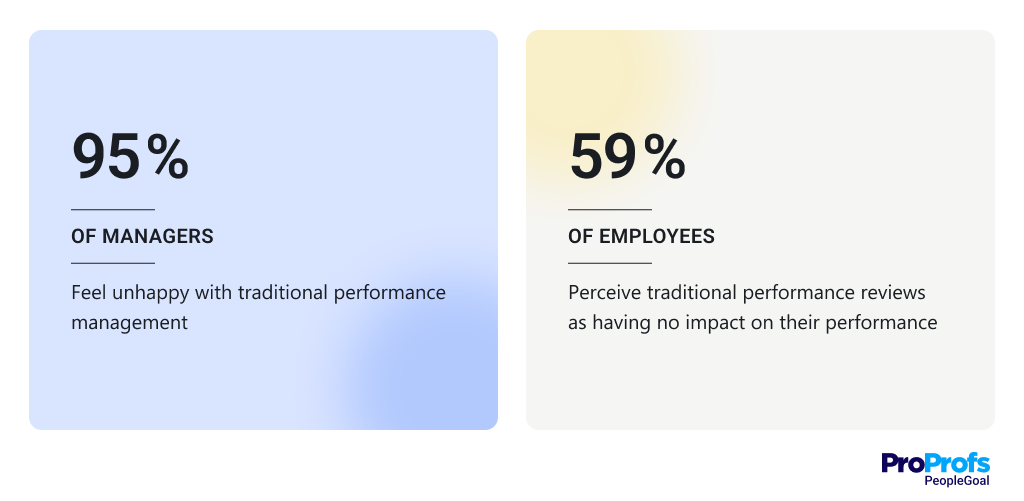

Most employee performance management systems don’t fail because companies don’t care. They fail because nobody questions the design. Goals set in January, forgotten by March. Feedback is delivered once a year, two weeks before anyone gets their rating.
A manager reading from notes that the employee has never seen. That’s not a performance system. That’s a paper trail.
I’ve run performance cycles, and the ones that actually move the needle share one thing: they treat performance as a continuous conversation, not a calendar event. Real-time feedback, cascading goals, structured reviews that contain zero surprises.
That’s the system I’m going to walk you through in this guide, including what the research backs, what I’ve seen work, and what quietly destroys manager credibility faster than almost anything else.
Who this is for:
- Managers chasing down 50 spreadsheets every December need a system that actually tells them where people stand in May
- Who lost a strong performer and realized, too late, that no one had an honest conversation with them for six months
- Someone building their first structured performance management process and doesn’t know where to start
- An HR director tired of defending gut-feel ratings to your leadership team
- A founder who knows your team needs structure but doesn’t have a full HR function to build it
What Is Employee Performance Management & Why Does It Fail?
Many people use Performance Management and Performance Appraisal terms interchangeably, but they are not the same thing. Performance appraisal is one part of a broader performance management process. Understand the difference here:
| Performance Management | Performance Appraisal |
| A continuous process focused on improving employee performance over time | A periodic evaluation used to assess employee performance at a specific point in time |
| Happens throughout the year through regular feedback, coaching, and goal tracking | Usually conducted quarterly, biannually, or annually |
| Focuses on growth, alignment, development, and long-term improvement | Focuses on measuring past performance against predefined criteria |
| Involves managers, employees, HR teams, and sometimes peers or cross-functional stakeholders | Typically involves the employee and direct manager |
| Results in ongoing coaching, development plans, goal adjustments, and performance improvement | Results in ratings, review summaries, compensation discussions, or promotion decisions |
I used to think performance management was what happened during review season. Set goals in January, check in sometime in the middle of the year, score everyone in December. That model has a fundamental flaw: by the time you’re evaluating someone, it’s too late to change anything.
The reason most employee performance management systems fail comes down to three patterns I’ve seen repeat across industries:
- Surprise factor: If an employee hears something new in their formal review, the process already failed them months earlier. A good performance management process should make formal reviews feel like a summary of conversations already had, not a revelation.
- Leadership vacuum: Poor performance is often a management failure disguised as an employee problem. Expectations were never defined. Feedback was never given in real time. The employee found out they were underperforming at year-end. That is not a performance issue. That is a communication failure.
- Activity metrics mistaken for performance data: Counting tasks closed, calls made, or lines of code written tells you very little about whether someone is creating actual value. When you measure activity, you get activity. People optimize for whatever the system rewards.
Why Is Performance Management Important for Business Outcomes?
Structured, continuous performance management directly improves employee engagement, goal alignment, and retention. Organizations that replace annual appraisals with ongoing feedback cycles consistently report higher productivity, lower voluntary turnover, and stronger manager-employee trust.
I’ll give you the honest answer: because without it, you’re running blind.
According to Gallup research in 2024, managers account for at least 70% of the variance in employee engagement scores. Engagement directly affects productivity, retention, and customer outcomes. Performance management is the mechanism through which managers either build high-performing teams or slowly drain them.
Here’s what structured, continuous performance management actually does at the organizational level:
- Creates alignment: Individual goals connect to team goals connect to company strategy. Everyone knows how their work contributes to something larger.
- Reduces recency bias: Because feedback happens throughout the year, evaluations reflect actual performance, not just the last 30 days before review season.
- Retains top performers: According to Gallup’s 2025 workplace findings, employees who receive meaningful feedback in the past week are nearly four times more likely to be engaged than those who receive feedback less frequently. Regular performance conversations help employees feel supported, recognized, and connected to their growth within the organization.
- Gives HR teams real data: Instead of gut-feel ratings, you get goal completion rates, feedback trends, development plan follow-through, and engagement signals over time.
A Real-World Example of Continuous Performance Management:
| Deloitte is one of the most cited examples of why organizations moved away from annual performance reviews. In its internal research, the company found that its traditional review process was consuming nearly 2 million hours per year globally while still failing to deliver timely, actionable feedback. That discovery pushed Deloitte to replace annual reviews with a more agile system built around frequent check-ins, short performance conversations, and future-focused coaching. Instead of asking managers to score employees once a year, the company shifted toward ongoing discussions about priorities, strengths, and next steps. The change became one of the most referenced examples of modern continuous performance management because it showed how faster feedback loops can improve both employee experience and managerial effectiveness. |
The shift from annual appraisals to ongoing feedback loops is not just a trend. It is a structural improvement in how work gets done.”
How Does the Performance Management Process Actually Work?
The performance management process is a six-stage continuous cycle: goal setting, progress monitoring, skill development, performance evaluation, recognition and rewards, and replanning. Each stage feeds the next, and the cycle runs throughout the year, not just at annual review time.
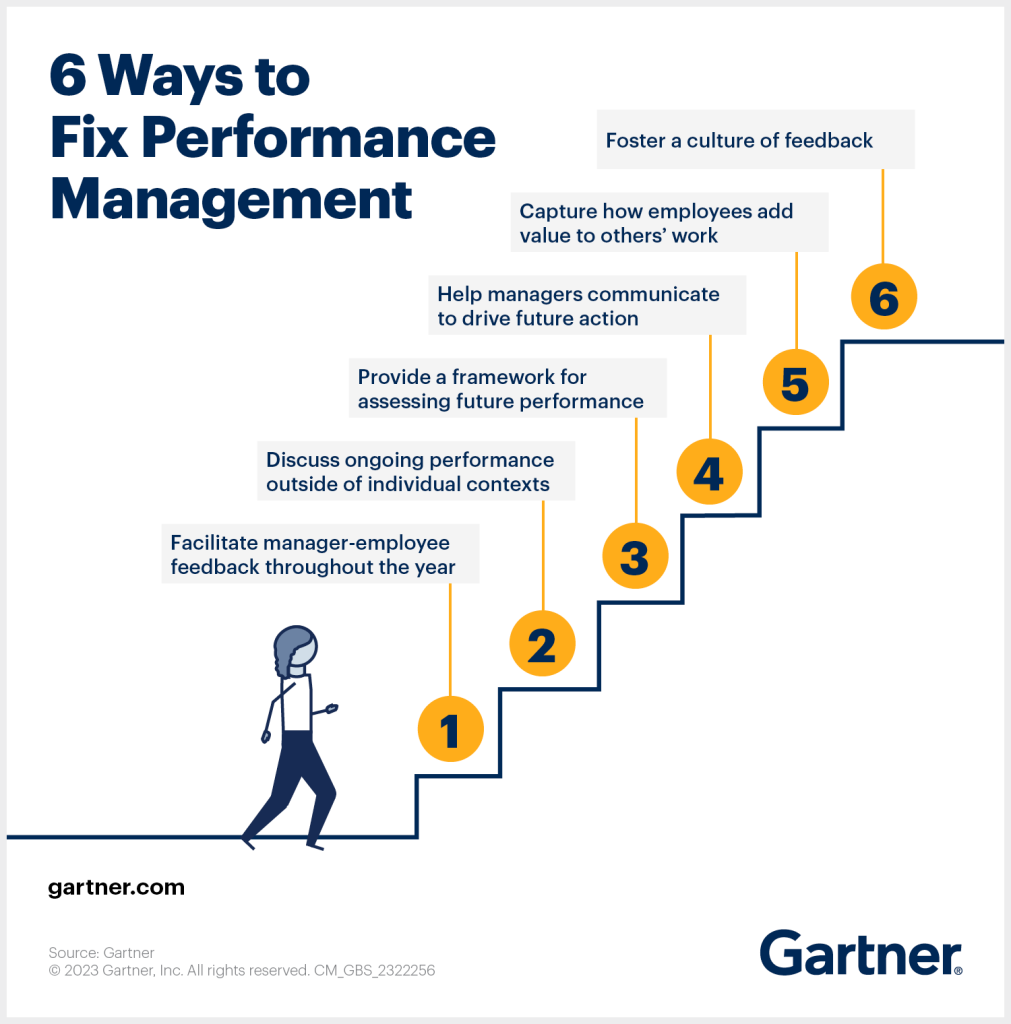
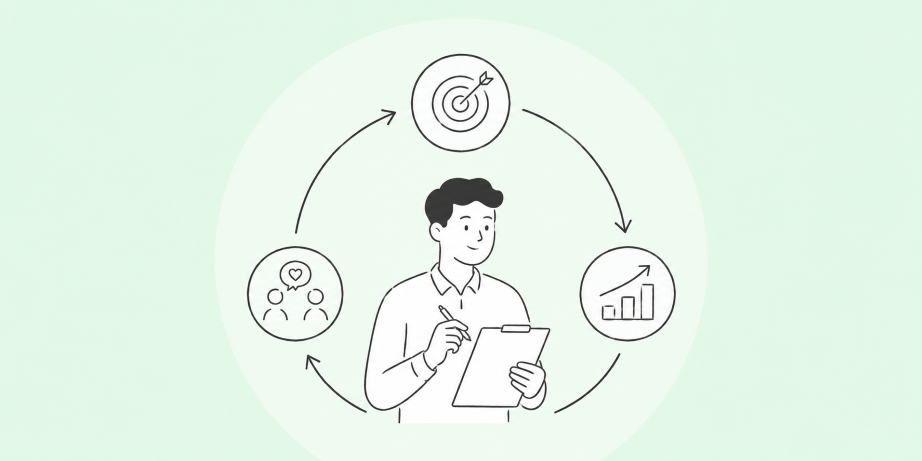
I think of the performance management process as a loop rather than a linear sequence. Each stage feeds back into the next, and the whole system runs continuously, not just at year-end. Here’s how I walk through each stage in practice.
Stage 1: Set Goals That Actually Mean Something
The first stage is planning, and most teams get it wrong by treating goal-setting as a formality.
What I do instead:
- Start with company-level OKRs (Objectives and Key Results), then cascade them down to team and individual levels so every goal connects to a larger priority
- Use SMART goals (Specific, Measurable, Attainable, Relevant, Time-bound) at the individual level for daily clarity
- Involve the employee in setting their own goals. People are more committed to targets they helped create
- Build in a review trigger: “If the company direction changes significantly, we revisit these goals immediately, not at the next scheduled check-in”
A prompt I give managers: “Before you finalize any goal with an employee, ask: if this person achieves exactly this goal, will it matter to the business in six months? If the answer is unclear, rewrite the goal.”
Stage 2: Monitor Progress Without Micromanaging
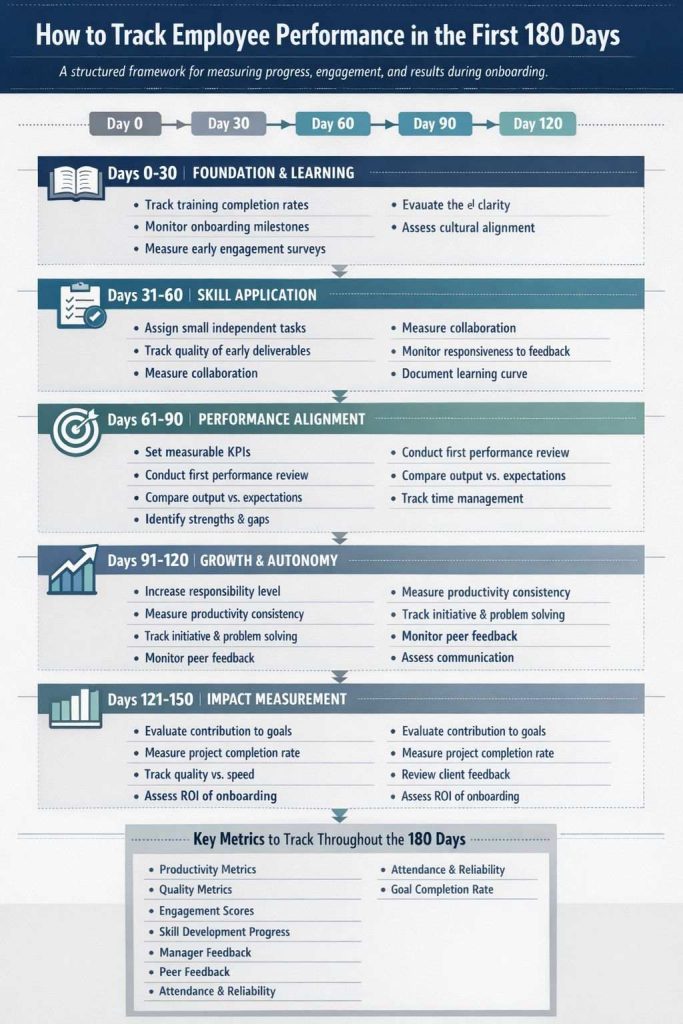
Progress monitoring is not surveillance. It is the practice of checking in consistently so that problems surface early enough to fix them.
What actually works:
- Weekly or bi-weekly 1:1s with a consistent agenda: wins, blockers, priorities
- After every meaningful conversation, send a brief written recap confirming what was discussed and what the next steps are. This eliminates “I never said that” situations and creates documentation without bureaucracy
- Use real-time employee performance tracking to see goal progress between conversations, so check-ins stay focused on what matters, not on status updates
What doesn’t work: Monthly check-ins where the manager asks “how’s everything going?” and the employee says “fine.” That is not monitoring. That is theater.
Stage 3: Develop Skills Before the Gap Becomes a Problem
Most organizations treat development as a post-review activity. Someone gets a low score, then gets sent to training. By that point, the gap has already affected performance, morale, and probably team dynamics.
I flip this: development is part of every performance cycle, not a consequence of underperformance.
How I structure it:
- After each goal check-in, ask: “What skill or resource would make the next milestone easier to reach?”
- Map development actions to specific role competencies, not generic “communication skills” or “leadership potential”
- Track development plan follow-through as a KPI, not as an optional add-on. If people create plans and never execute on them, the review process is just paperwork
A competency-based approach works well here. When you assess people against role-specific criteria rather than general impressions, you get development plans that are actually relevant to where the person is in their career.
Stage 4: Conduct Performance Reviews That Don’t Surprise Anyone
A performance review should feel like a formal summary of conversations already had. If someone is hearing something for the first time in a review, something broke down in stages 2 and 3.
The review cycle I recommend for most teams:
| Review Type | Frequency | Who Is Involved |
| Informal check-in | Weekly or bi-weekly | Manager + employee |
| Formal 1:1 review | Quarterly | Manager + employee |
| 360-degree feedback | Semi-annual or annual | Peers, direct reports, manager |
| Self-assessment | Each formal review cycle | Employee |
| Full performance appraisal | Annual | HR, manager, employee |
On 360-degree feedback specifically: This is the most powerful tool in the performance management system when done right.
- It collects input from peers, managers, direct reports, and sometimes clients, giving a complete picture of how someone actually shows up at work.
- The common mistake is running anonymous 360 reviews with vague questions.
- Build your 360 review forms around observable behaviors and specific examples. “Demonstrates accountability by communicating delays proactively” is useful. “Is a team player” is not.
This is exactly the fragmentation problem PeopleGoal solves. When 360 feedback lives in one system alongside goals and check-in history, the evaluator nominations are automated, completion is tracked in real time, and by the time you sit down for the formal 1:1, the data is already there waiting for you. You’re not chasing anyone down. You’re having a better conversation.
Watch to dive into details of 360-degree feedback: https://www.youtube.com/watch?v=uq0QmyXA05g
Stage 5: Recognize and Reward in Ways That Actually Land
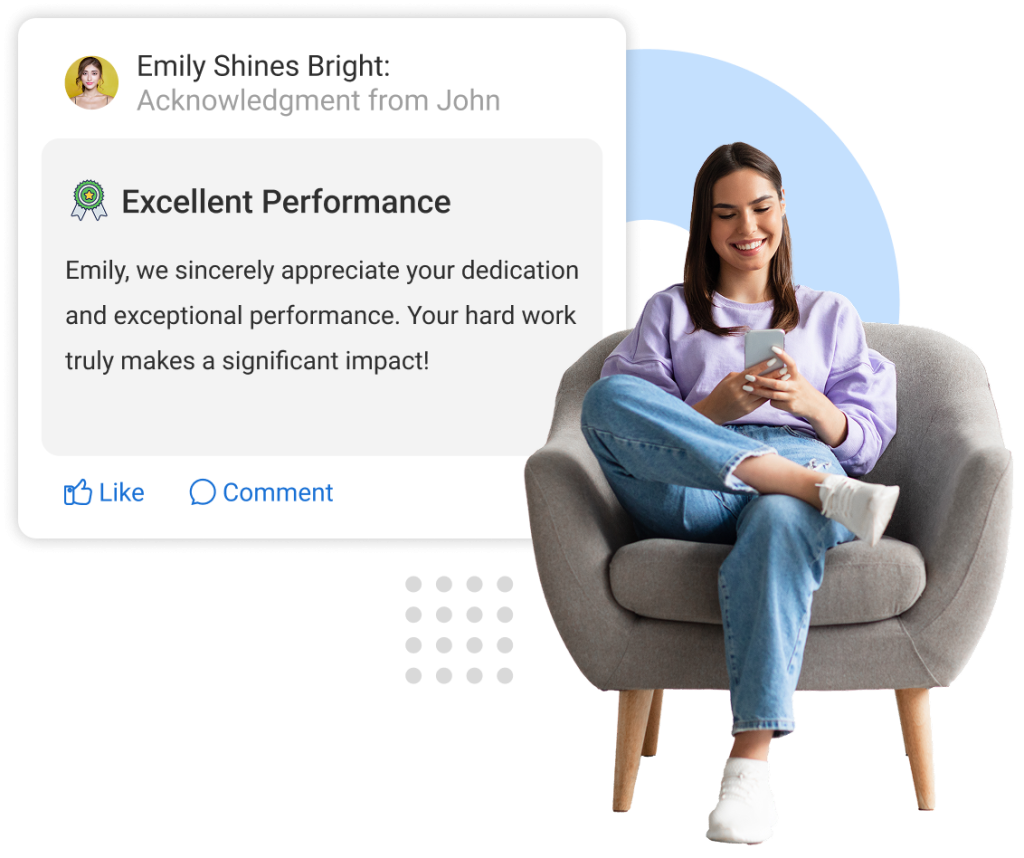
Employee recognition is one of the most underutilized performance tools I’ve seen. Most managers default to either saying nothing or giving praise so generic that it means nothing.
What specific recognition looks like:
Instead of: “Great quarter, keep it up.”
Try: “The way you handled the escalation in the Henderson account without letting it damage the relationship is exactly what I mean when I talk about client ownership. That’s the behavior that gets noticed here.”
The second version is specific, tied to observable behavior, and tells the employee exactly what to repeat. That is recognition that actually reinforces performance.
On rewards: link recognition to the behaviors and outcomes you actually want more of, not just to tenure or likability. Anonymous peer nomination systems work well for surfacing contributions that managers don’t always see directly.
Stage 6: Replan and Reset the Cycle
After each review cycle, I revisit goals, revise development plans, and reset priorities based on what’s changed in the business. This is what makes performance management continuous rather than episodic.
The question I ask at every reset: “What do we know now that we didn’t know when we set these goals, and how does that change what this person should be focused on?”
How Do I Know If My Performance Management Process Is Actually Working?
Measure these six metrics to evaluate whether your performance management process is improving outcomes or just generating paperwork: goal completion rate, review cycle completion rate, self-assessment participation, development plan follow-through, top performer retention, and engagement scores correlated to review cycles.
This is where most HR teams drop the ball. They build the process but never measure whether it’s improving anything. Here are the metrics I track and what they actually tell me:
| Metric | What It Measures | What Success Looks Like |
| Goal Completion Rate | How consistently employees and teams achieve their goals each quarter | Around 70–80% of goals are completed without employees feeling overloaded |
| Review Cycle Completion Rate | Whether managers and employees complete reviews on time | Reviews are completed consistently with minimal follow-ups from HR |
| Self-Assessment Participation | Employee involvement and ownership in the review process | Most employees actively complete self-assessments and provide thoughtful input |
| Development Plan Follow-Through | Whether employees actually act on agreed development goals | Development plans lead to visible skill improvement, coaching, or role growth |
| High Performer Retention | Ability to retain top-performing employees over time | Strong performers stay engaged, grow internally, and rarely leave voluntarily |
| Engagement Scores After Reviews | Employee sentiment following review cycles | Engagement scores improve or stay stable after performance discussions and feedback cycles |
What Are the Best Employee Performance Management Methods for Your Team?
The most effective performance management systems combine multiple methods rather than relying on one. MBO and continuous check-ins form the foundation.
360-degree feedback, competency-based reviews, and BARS add depth and objectivity depending on team size, structure, and maturity.
I get this question constantly: “Which performance management method should we actually use?” The honest answer is that no single method works in isolation. The strongest systems I’ve seen combine two or three frameworks into one repeatable cycle.
Here’s how I think about each one and, more importantly, when to reach for it.
| Method | Best Used When | Primary Outcome | What to Watch Out For |
| Management by Objectives (MBO) | Individual accountability is central and goals are stable quarter to quarter | Clear ownership of measurable targets | Goals become irrelevant if business priorities shift and no one updates them |
| 360-Degree Feedback | You need a fuller picture than manager-only evaluations can give | Holistic view of behavior and impact | Vague questions produce vague feedback. Make every question behavioral and specific |
| Competency-Based Reviews | You’re building career ladders or having promotion conversations | Structured development tied to role criteria | Competency frameworks need updating as roles evolve, otherwise they measure the wrong things |
| Continuous Feedback and Check-ins | Your team moves fast and priorities shift frequently | Real-time course correction | Without structure, check-ins become status updates. Always tie them to a consistent agenda |
| BARS | You want to reduce subjectivity and manager inconsistency in ratings | Fairer, more consistent evaluations | Takes time to build well. Generic BARS templates are nearly useless |
| KPIs | You have clear, quantifiable role outputs to track | Objective performance benchmarking | Never use KPIs as the only measure. Activity numbers without qualitative context mislead |
| Self-Assessment | Every formal review cycle, without exception | Employee ownership and self-awareness | Pair it with manager input. Self-assessment alone creates an echo chamber |
A few things I’ve learned from applying these in practice:
- Start with MBO and continuous check-ins as your foundation. Everything else layers on top.
- Add 360-degree feedback once your managers are actually trained to act on it, not before. Collecting input no one uses destroys trust faster than not collecting it at all.
- Use BARS when you notice two managers evaluating the same behavior and producing wildly different ratings. That inconsistency is a signal, and BARS fixes it at the criteria level.
- Never let KPIs become the whole story. An employee who hit every number but left three colleagues burned out in the process did not perform well. Build behavioral criteria alongside your KPIs.
The combination that works for most mid-size teams: MBO for goal structure, continuous check-ins for real-time course correction, and 360-degree feedback twice a year for a complete view of how someone actually operates. That is the performance management framework I’d build first.
What Are the Performance Management Best Practices That Actually Move the Needle?
The performance management best practices that consistently improve outcomes go beyond goal-setting and communication. They address manager readiness, psychological safety, impact measurement, and the separation of development conversations from compensation decisions.
Most best-practice guides tell you to “communicate clearly” and “set measurable goals.” You already know that. Here’s what actually makes the difference:
1. Separate performance conversations from compensation conversations
When a performance discussion is tied directly to salary outcomes, people get defensive. They stop being honest about where they’re struggling. Run development conversations separately from compensation reviews. The first conversation should be about growth. The second can be about money.
2. Train managers first, always
The most common reason performance management fails is not the system. It’s that managers aren’t equipped to have the conversations. A performance management framework is only as effective as the people running it. Before you launch any new review cycle, run a manager training session specifically on delivering feedback and coaching for growth, not just evaluation.
3. Define impact, not activity
Replace activity metrics with impact questions: “What moved as a result of your work this period?” An employee who made 80 calls and converted 2 is less effective than one who made 30 and converted 12.
Build your evaluation criteria around outcomes and use NLP-based framing in your review language: “Delivered X outcome that resulted in Y” is stronger and more specific than “shows initiative.”
4. Build psychological safety before asking for honest feedback
If employees don’t trust that feedback won’t be used against them, they won’t give it honestly in 360-degree feedback cycles or self-assessments. Psychological safety is a prerequisite, not a nice-to-have. Signal it through how leadership responds to critical feedback in all-hands settings before you ask for it in a review form.
5. Prompt your managers with specific language
Try giving managers a concrete prompt for their next 1:1: “What’s one thing I could change that would make your work significantly easier this quarter?” That single question surfaces blockers, unmet expectations, and development needs faster than any annual survey.
The best managers I’ve worked with use prompted questions consistently, not because they can’t think of what to say, but because structure produces better answers.
What a Good Performance Management System Actually Feels Like
I want to name something that performance management guides rarely say out loud: the anxiety of managing performance is real.
The dread of having “the talk” with a bottom performer. The discomfort of giving critical feedback to someone you genuinely like. The fear that you’ll say something wrong in a review and end up in an HR conversation yourself.
These are not irrational feelings. They’re the emotional job behind the search for better performance management.
Here’s what changes when the system actually works:
- You’re not scrambling to remember what someone did six months ago because it’s documented throughout the year
- The formal review is not a confrontation because the feedback was already delivered, already discussed, already acted on
- You’re not guessing whether a low performer can improve because you have a documented development plan with clear milestones and check-in dates
- You’re not dreading the conversation because you’ve been having it, in smaller doses, every two weeks
The goal of a good performance management system is not just better reviews. It’s a manager who feels in control of their team’s trajectory and an employee who never feels blindsided. That peace of mind is the actual product.
What Features Does Your Performance Management System Actually Need?
An effective employee performance management system needs 360-degree feedback, OKR and goal tracking, continuous feedback tools, customizable review workflows, performance analytics, development plan integration, automated scheduling, and HRIS integrations. The most common failure is fragmentation across too many disconnected tools.
Based on what I see HR managers and people ops teams consistently ask for, and consistently fail to get from their current tools, here is the practical feature list:
- 360-degree feedback: Multi-rater input with automated reminders, anonymous peer reviews, and response tracking
- OKR and goal tracking: Individual, team, and company-level alignment visible in one dashboard
- Continuous feedback tools: Real-time feedback requests between formal review cycles, not just during them
- Customizable review workflows: Forms and cycles built around your actual process, not a generic template
- Performance analytics and dashboards: Goal completion trends, team-level insights, exportable reports
- Development plan integration: Review outcomes connected directly to learning actions and next steps
- Automated scheduling: Review cycle reminders and escalations without manual follow-up
- HRIS integrations: Direct sync with BambooHR, Workday, ADP, Slack, Microsoft Teams, and Google Calendar
The real problem is not a missing feature. It is managing performance across five disconnected tools simultaneously: goals in a spreadsheet, feedback in Slack, reviews in a PDF, development plans in a Word doc, and reports built manually in Power BI every quarter. That fragmentation creates blind spots and burns admin time on work that should run automatically.
PeopleGoal consolidates goal tracking, continuous feedback, 360-degree feedback workflows, development plans, and performance analytics into one platform, with integrations to the HRIS tools most teams already use.
How Do I Fix Performance Management When Managers Are the Problem?
Before flagging an employee for underperformance, managers should run a self-diagnostic to rule out systemic causes: unclear expectations, missing support, capacity overload, or inadequate feedback during the performance period. The 5 Whys technique helps trace root causes accurately.
Before you flag an employee for underperformance, I always ask managers to run through this self-check first.
The Manager’s Mirror: A Framework for Root Cause Diagnosis
- Did I clearly define what success looks like in this role from day one?
- Did I communicate expectations in a format the employee could reference later?
- Have I removed blockers that were in their way?
- Did I give feedback close to the moment it happened, or let things accumulate?
- Have I had an honest conversation about whether this is a capacity problem (not enough bandwidth) or a capability problem (skill gap or role mismatch)?
That last distinction matters enormously. A capacity problem and a capability problem require completely different responses.
- Use the 5 Whys technique: Ask “why is this happening?” five times in sequence. You’ll almost always trace underperformance back to something systemic, not just individual.
- On PIPs: Performance Improvement Plans work when they are used as genuine tools for improvement, with specific actions, clear timelines, regular check-ins, and documented support.
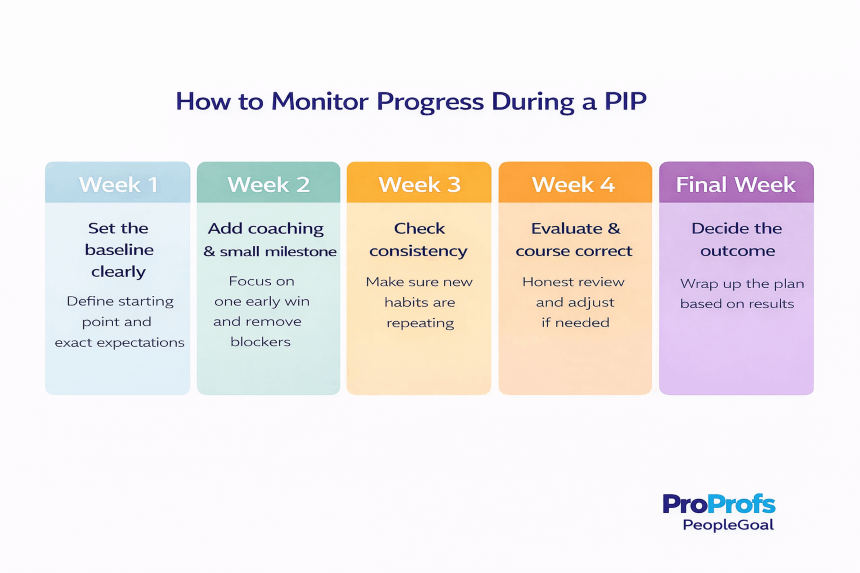
They fail when they are used as exit documentation dressed up as a development plan. If you’ve been doing continuous feedback correctly, a PIP should never come as a surprise to the employee receiving it.
Stop Managing Performance. Start Building a System That Does It for You
A strong performance management process is not about creating more review forms or adding more meetings to everyone’s calendar. It’s about building a system where goals stay visible, feedback happens early, development becomes continuous, and employees never feel blindsided by a review conversation.
The companies that get this right are usually the ones that treat performance as an ongoing dialogue instead of a once-a-year HR exercise.
If your current process still lives across spreadsheets, PDFs, disconnected feedback threads, and manual follow-ups, the next step is not adding more complexity. It’s simplifying the workflow so managers can focus on coaching instead of administration.
That’s where platforms like PeopleGoal become useful. Bringing goals, 360 feedback, development plans, check-ins, and analytics into one system makes the process easier to run consistently and much easier to improve over time. The best place to start is by auditing your current review cycle, identifying the biggest friction points, and fixing one broken stage at a time.
Frequently Asked Questions
What are the components of a performance management system?
A complete performance management system includes goal and OKR tracking, continuous feedback mechanisms, structured performance reviews including self-assessment and 360-degree feedback, employee development plans, recognition systems, and performance analytics dashboards that surface goal completion rates and engagement trends across the organization.
Why do organizations use performance management systems?
Organizations adopt structured performance management systems to replace manual, inconsistent processes with trackable, automated workflows. The goal is to reduce HR admin burden, increase evaluation consistency across managers, give employees clearer performance expectations, and create a direct connection between individual performance and business results.
What is the difference between performance management and performance appraisal?
Performance management is a year-round continuous process covering goal setting, feedback, and employee development. A performance appraisal is a formal, periodic evaluation that sits within that process. An appraisal is one component of performance management, not a synonym for it. Treating them as the same thing is one of the most common reasons performance systems fail.
What is 360-degree feedback in performance management?
360-degree feedback collects performance input from multiple sources simultaneously: peers, direct reports, managers, and sometimes external clients. It gives a more complete picture of how someone performs across different relationships and working contexts, and significantly reduces the blind spots that come from manager-only evaluations.
How do I measure whether my employee performance management process is working?
Track six metrics: goal completion rate per quarter, review cycle completion rate across managers, self-assessment participation, development plan follow-through, voluntary turnover among high performers, and engagement survey scores correlated to formal review cycles. These tell you whether the system is improving performance or just producing paperwork.
Ready to 3x Your Teams' Performance?
Use the best performance management software to align goals, track progress, and boost employee engagement.